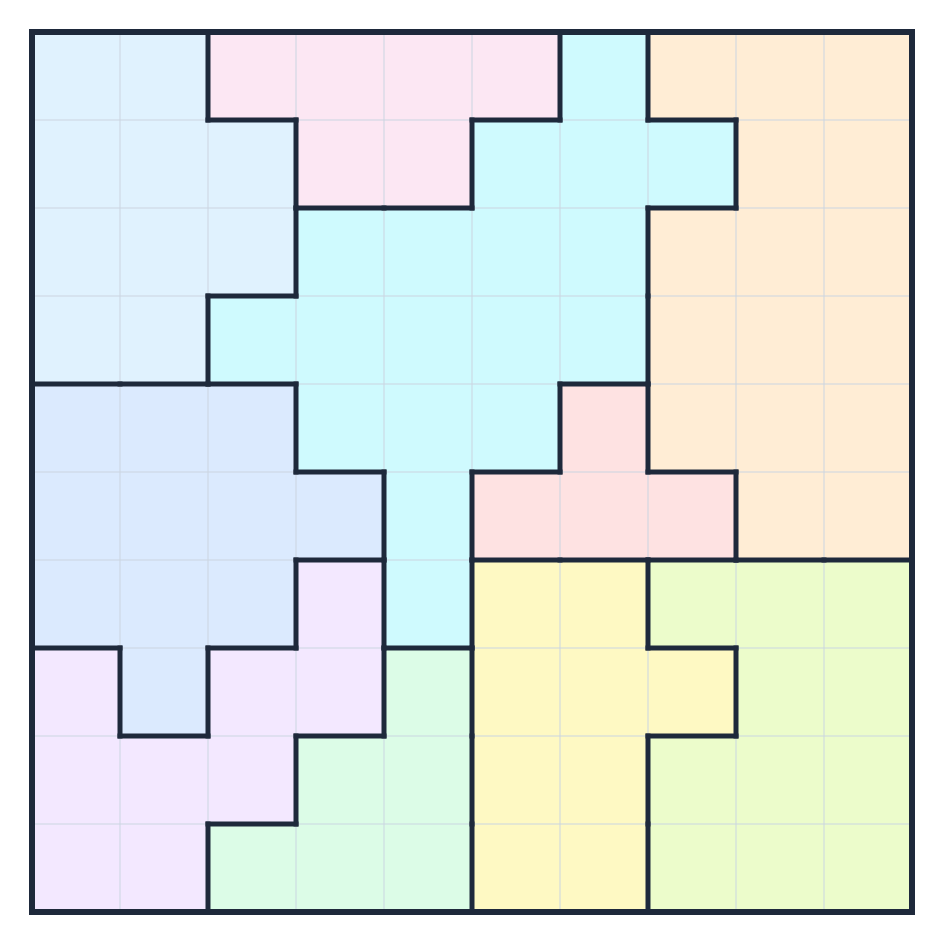
In this article in the series, we are moving past the classic grids filled with numbers or letters and shooting straight for the stars. Star Battle shares some logical DNA with the puzzles we have previously explored, but it shifts your attention away from the symbols placed in the grid and towards the relationships between rows, columns, and regions.
As far as I can determine, the history of Star Battle began in the Netherlands in 2003. That makes it younger than many classic logic puzzles, but after more than two decades, it can hardly be called new. The puzzle is generally credited to Dutch puzzle designer Hans Eendebak, who created it for the 12th World Puzzle Championship, held at the Papendal Sports Complex in Arnhem.
Star Battle was probably influenced by an earlier puzzle called Cattle, created by Tim Peeters. Cattle already featured irregular regions and a rule preventing objects from touching. However, instead of requiring the same number of objects in every row and column, their totals were provided as clues outside the grid, somewhat like in Battleships.
Over time, Star Battle has appeared under several different names, including Two Not Touch, Queens, Starstruck, and simply Stars. In my own collections, you will find it under the name Wildflowers. I decided to move away from the battle theme and choose something a little more peaceful and calming—a small counterbalance to these crazy times. The classic form of the puzzle uses two stars in every row, column, and region, but more about that later.
And Now, the Rules
Star Battle is played on a square grid divided into irregularly shaped regions. Your goal is to place stars in the grid while satisfying three main conditions:
Each row must contain the required number of stars.
Each column must contain the same required number of stars.
Each outlined region must also contain that number of stars.
The required number depends on the puzzle. In a one-star puzzle, every row, column, and region contains exactly one star. In a two-star puzzle, each contains exactly two stars, and so on.
Stars are not allowed to touch one another. This includes touching along an edge or at a corner, so two stars cannot occupy neighboring cells horizontally, vertically, or diagonally.
Cells that cannot contain stars may be marked as empty to help you keep track of possible and impossible positions. The puzzle is complete when every row, column, and region contains the correct number of stars and no two stars touch.
The beauty of Star Battle is that its rules are simple enough that you should not have to read them twice. However, one look at the grid can still leave you completely star-struck—and yes, you should probably expect a few more star jokes before this article is finished.
The puzzle’s complexity comes from the shapes of its regions. I struggle to think of another puzzle in which the shapes and positions of the regions influence the solving process quite as much as they do in Star Battle. That is also what makes every grid feel different.
Although the classic version usually uses two stars in every row, column, and region, first-time solvers should begin with a one-star puzzle. This gives you a chance to discover the logic hidden in the grid without having to track several stars and their interactions at the same time.
This logic can be difficult to transfer directly from other puzzle types. Once you become comfortable with one-star puzzles, you can move on to the two-star version. The basic principles remain the same, but the interactions between stars become much more complex.
One-star puzzles are especially well suited to quick solving sessions and puzzle apps. Two-star puzzles usually require a little more time, careful observation, and forward planning. Of course, the size of the grid also plays a major role in the difficulty. Larger grids offer many more possibilities and therefore create greater complexity. After all, Star Battle is largely a puzzle of eliminating cells until only the correct positions remain.
Solving a Two-Flower Puzzle
Let’s now solve a relatively simple 8×8 grid together and go through some of the basic techniques you will use in many Star Battle puzzles. As in my puzzle collections, I will use flowers instead of stars.
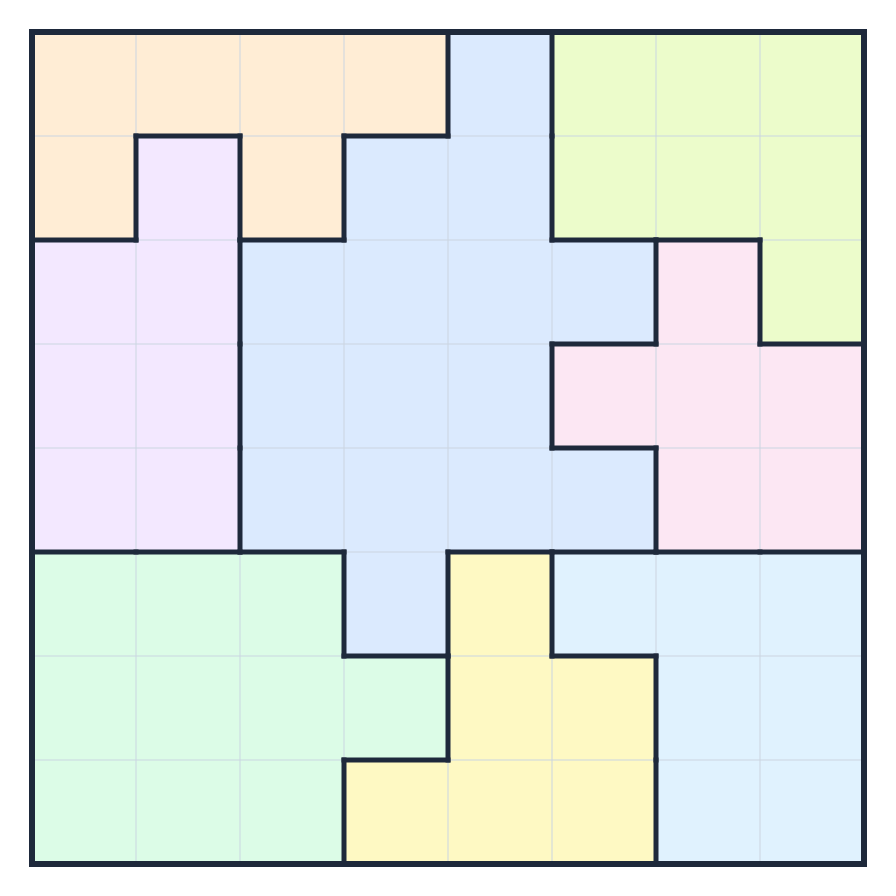
When you first look at an empty grid, its weak points may not be immediately obvious. A good place to begin is usually a small region or a region in which placing a flower in a particular cell would eliminate every other possible position within that region.
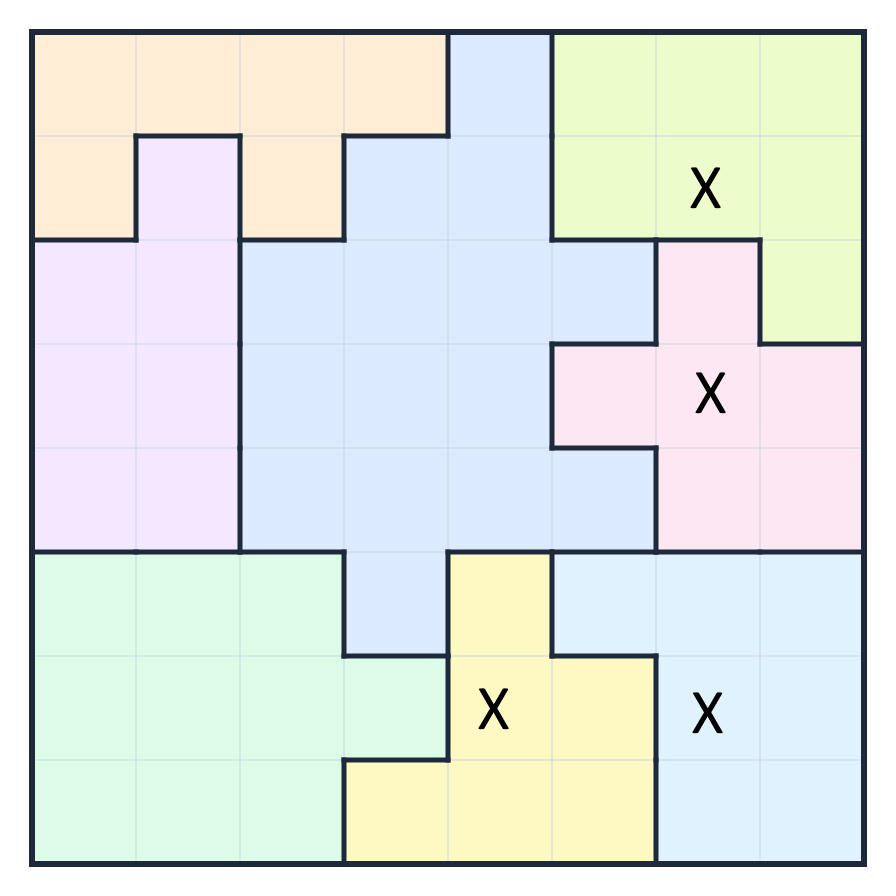
In this grid, however, we do not have any regions small enough to give us such an easy entry point. We cannot immediately place a flower or even narrow one down to a pair of cells in the same row or column.
For our first step, we will instead identify several cells in which placing a flower would make it impossible to place the second flower in the same region. Those cells can be eliminated immediately. This may not give us our first flower yet, but it is already a useful step forward.
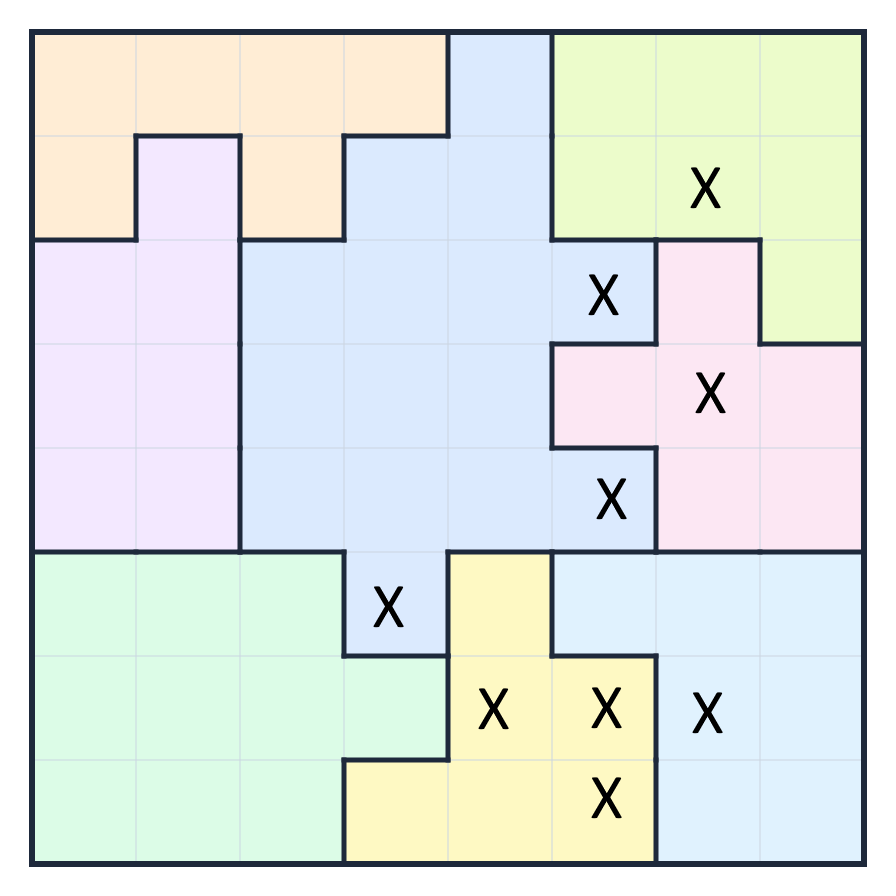
The next step is slightly more complex, but it introduces one of the most important strategies used in Star Battle.
Look at the bottom of the puzzle. Three regions occupy the bottom three rows. Together, those three rows must contain six flowers—two in each row. The three regions must also contain six flowers in total—two in each region.
This means those three regions will account for all six flowers required in the bottom three rows. Therefore, no flower belonging to another region can be placed within those rows. In our puzzle, this allows us to eliminate R6C4, which belongs to the central region, as a possible flower position.
Now look at the right side of the grid. We can apply the same reasoning to three regions occupying three columns. This time, the deduction allows us to eliminate several additional cells in C6.
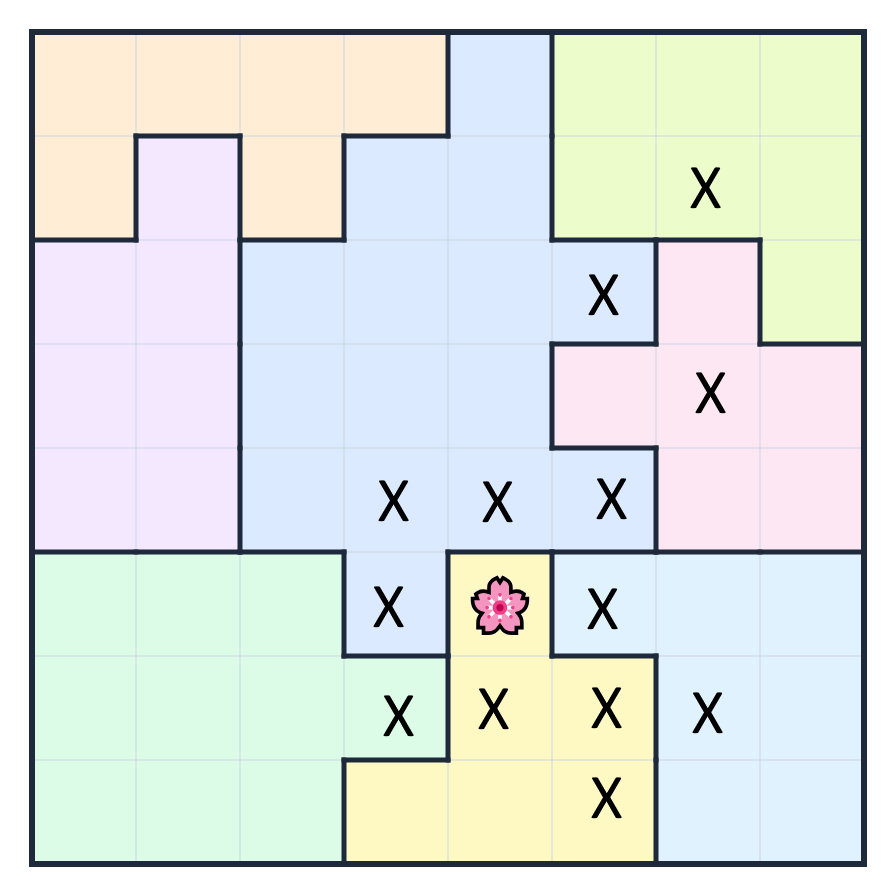
Thanks to these eliminations, we can now place our first flower with certainty at R6C5.
Why can we be certain?
Only three possible cells remain in the bottom-central region. The two lower cells touch one another, so they can contain no more than one flower between them. Because the region requires two flowers, the other flower must be placed in the upper cell, R6C5. We will determine the position of the lower flower later.
After placing the flower, we can eliminate every cell touching it horizontally, vertically, or diagonally.
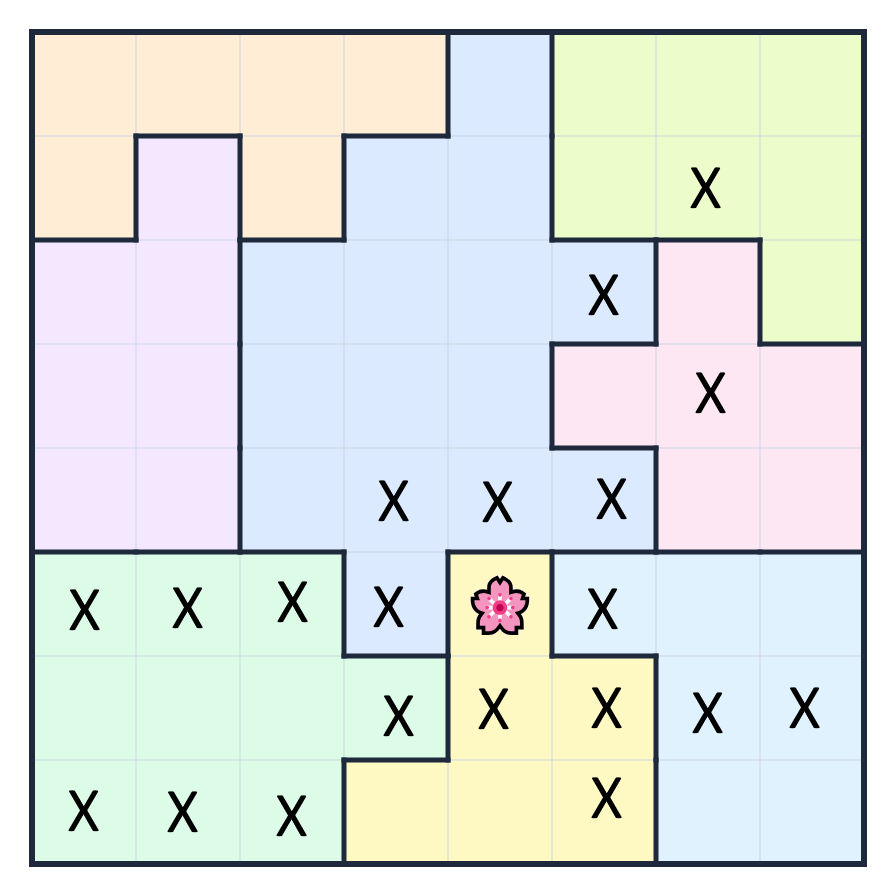
Now something interesting happens in the bottom-right region. We can eliminate R7C7 because placing a flower there would prevent us from fitting the region’s second flower.
This effectively divides the remaining positions into two groups. One flower must be placed in the upper pair, R6C7 or R6C8, while the other must be placed in the lower pair, R8C7 or R8C8.
This gives us more cells to eliminate. Row 6 already contains one flower at R6C5, and we now know that its second flower must be somewhere in the bottom-right region. Therefore, the region on the left cannot contain a flower in Row 6, so we can eliminate all of its remaining Row 6 cells.
The same reasoning applies to Row 8. We do not yet know the exact positions of its flowers, but we know that one will come from the bottom-central region and the other from the bottom-right region. Therefore, the bottom-left region cannot contain a flower in Row 8, and we can eliminate those cells as well.
Only three possible cells remain in the bottom-left region, all in Row 7. Because the region requires two flowers and flowers cannot touch, they must be placed at R7C1 and R7C3, with one empty cell between them.
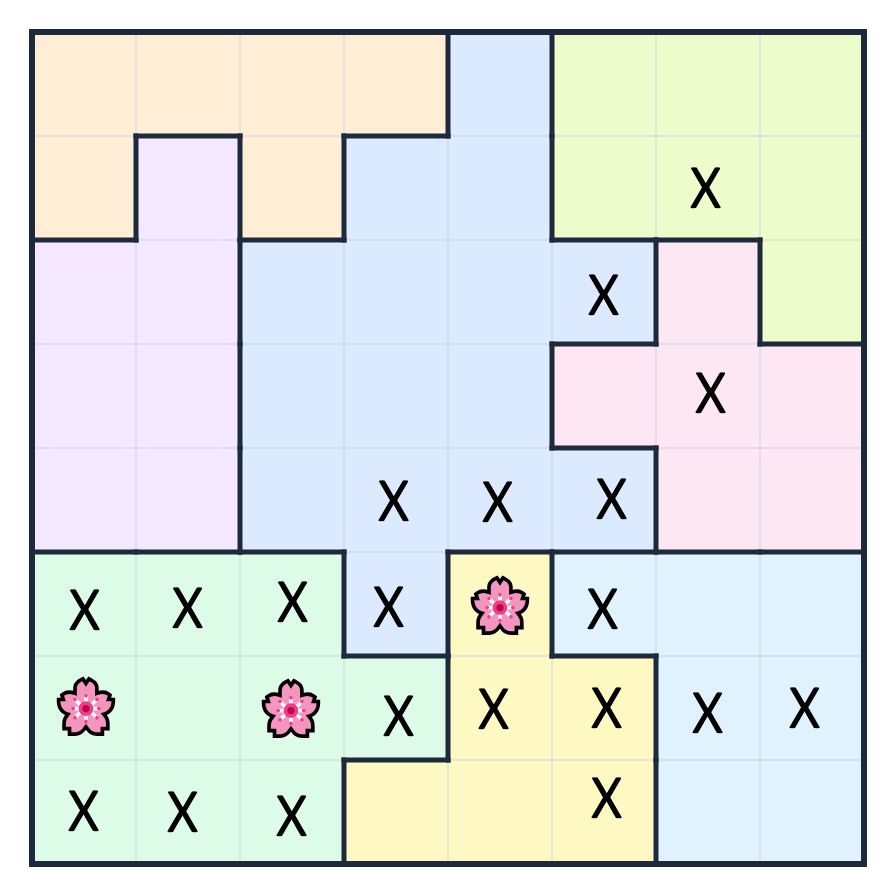
The no-touching rule now allows us to eliminate R8C4. This leaves R8C5 as the only available position for the second flower in the bottom-central region.
Column 5 now contains both of its required flowers, so every other cell in that column can be eliminated.
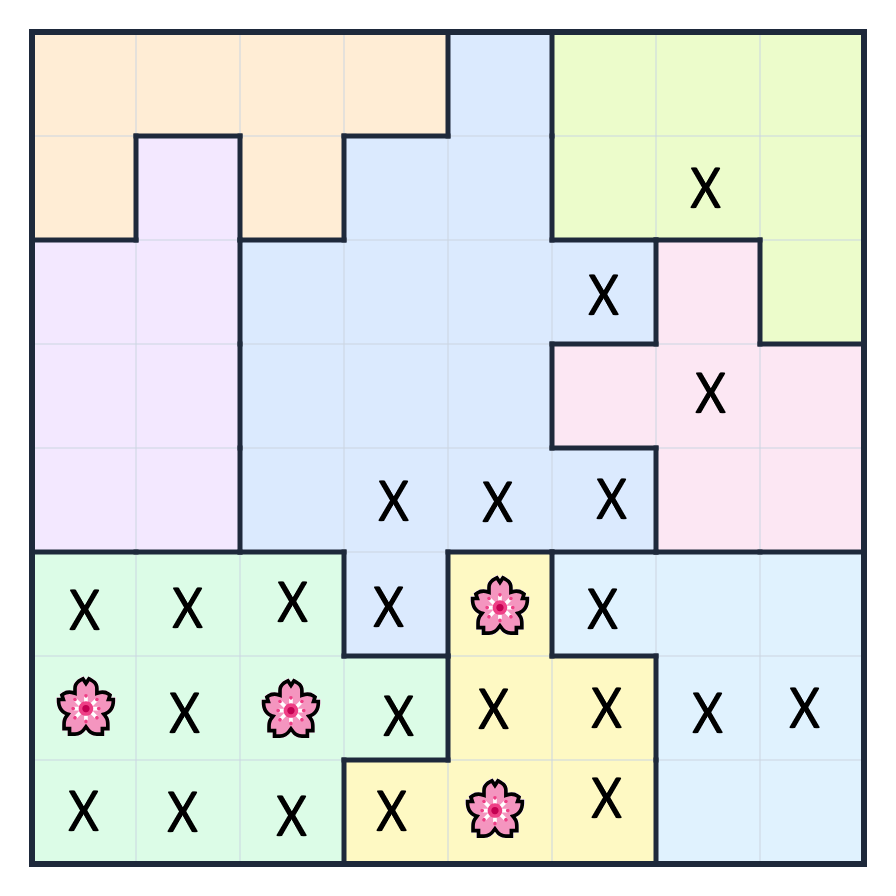
Next, we focus on Column 6, where only three possible cells remain. The two touching cells near the top can contain no more than one flower between them. Since the column needs two flowers, its other flower must be placed at R4C6.
Once again, we eliminate every cell surrounding the newly placed flower.
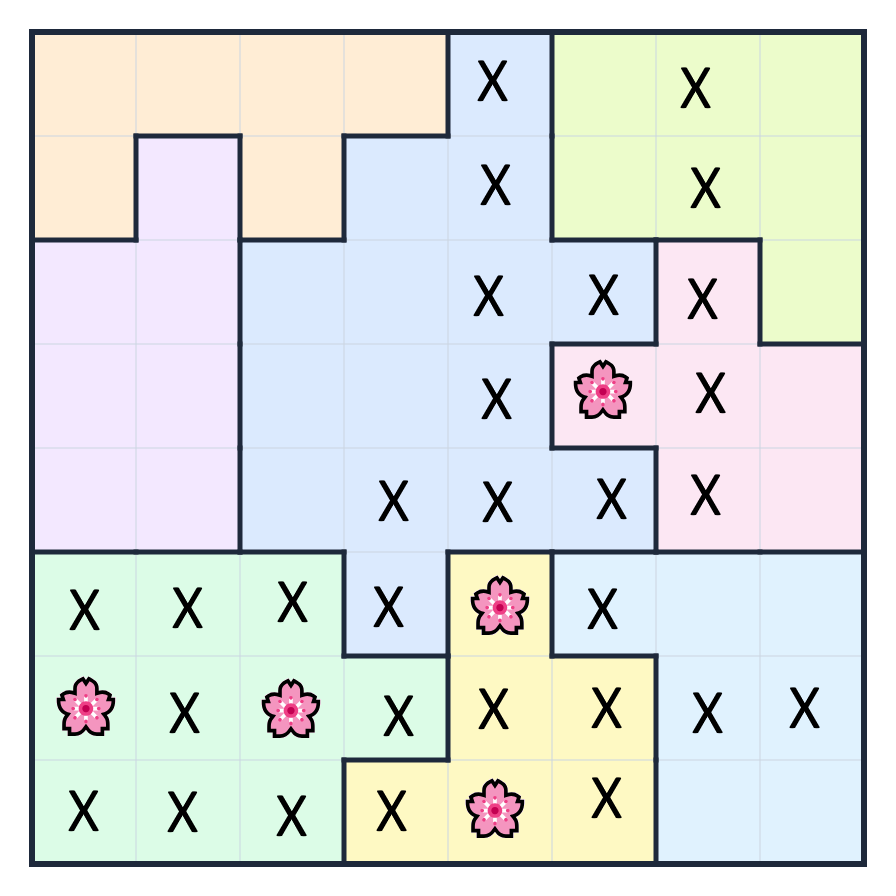
We can now determine both flowers in the bottom-right region. The same type of positional reasoning also helps us with the regions above it. The top-right region must contain one flower in C6 and one in C8, while the middle-right region also contains one flower in C8.
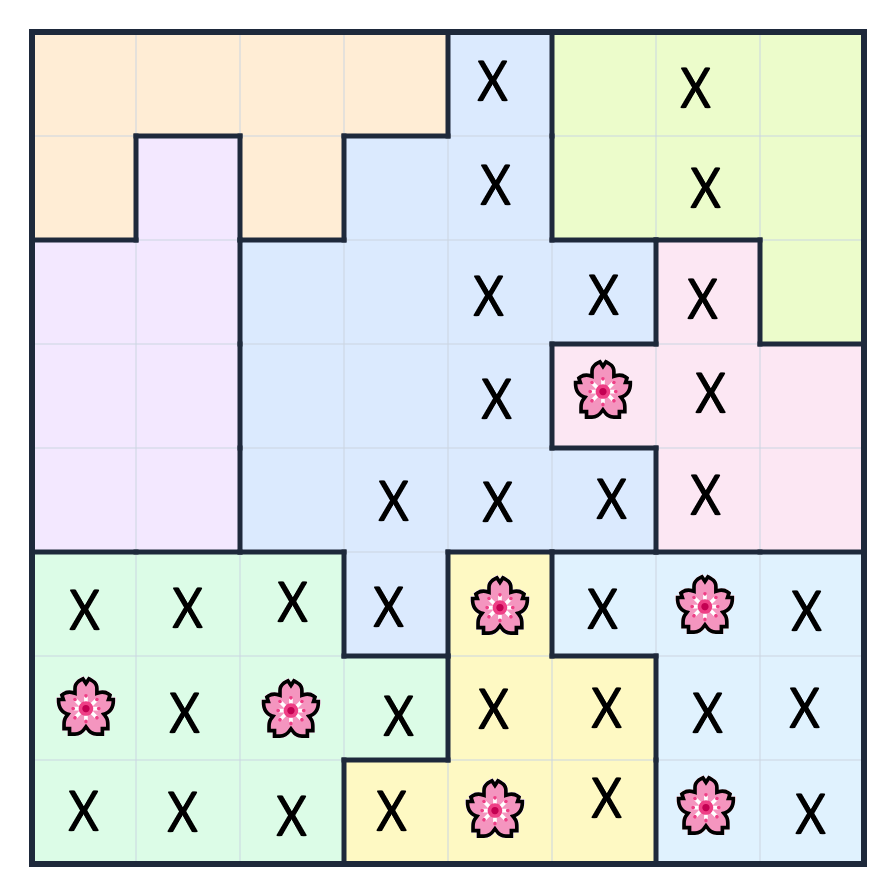
Column 8 is therefore complete, and all its remaining cells can be eliminated. This means that the flowers in the bottom-right region must be placed in Column 7.
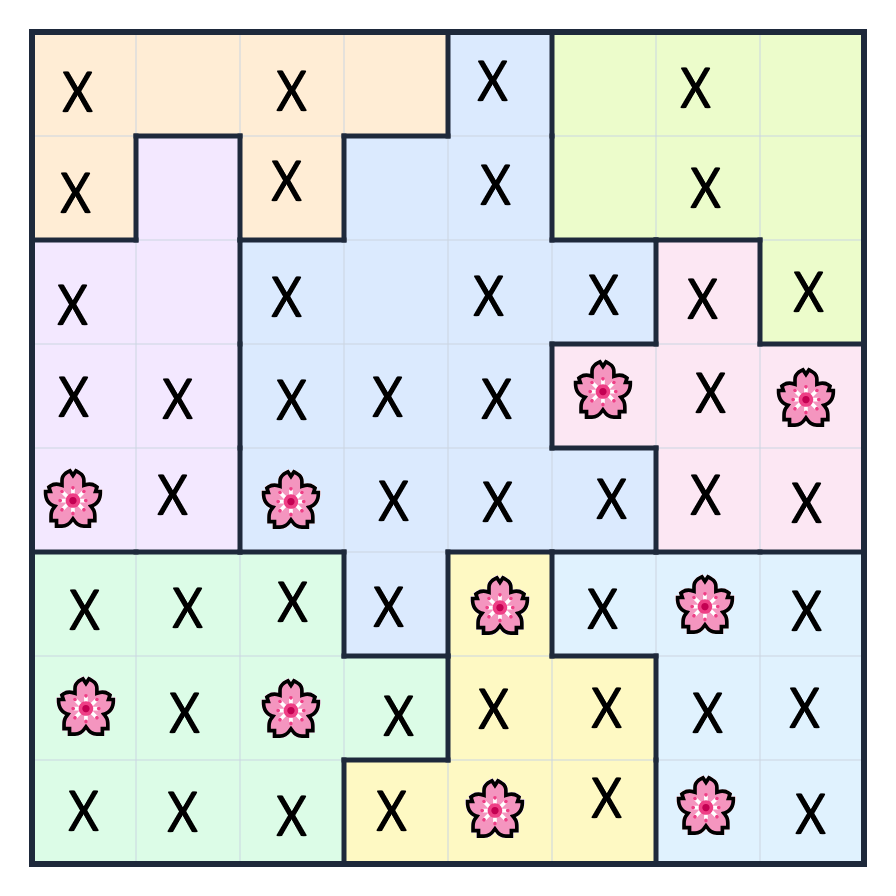
The puzzle is now almost complete.
After eliminating another cell in the middle-right region, only one possible position remains for its flower. Placing it opens the way to solving the central regions.
Row 5 is reduced to exactly two possible flower positions. Once those flowers are placed, Row 3 is also left with only two viable positions.
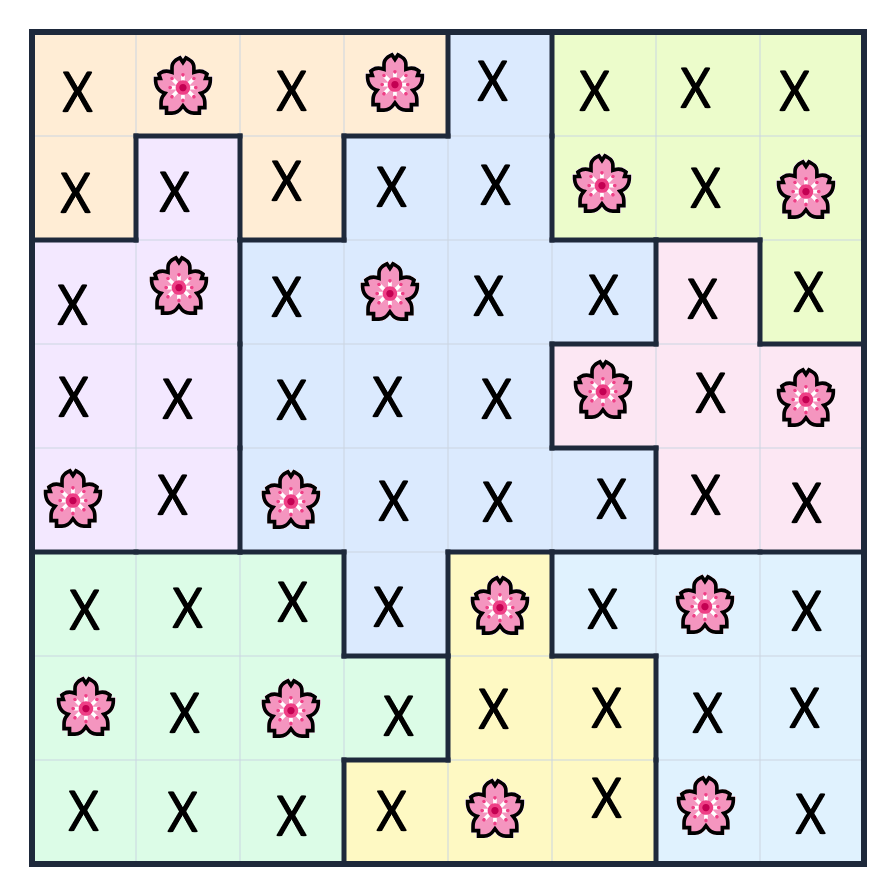
From there, Rows 1 and 2 can be completed, and the puzzle is solved.
Through hardships to the stars!
Variants
I hope you enjoyed this puzzle walkthrough. You can find Star Battle puzzles throughout the internet, as well as in my printable PDFs.
There are also many variants to explore. Even within what we might call the classic form, puzzles can vary in grid size and in the number of flowers required in each row, column, and region.
Other variants change the structure or add new types of clues. Some provide information outside the grid, while others combine Star Battle with familiar puzzle styles such as Sudoku, Battleships, or even Slitherlink.
I hope you will explore this wider Star Battle universe and find the version that suits you best.
Star Battle is an especially refreshing puzzle when you have had enough of grids filled with numbers, calculations, or letters. It challenges your brain in a different and more structural way, asking you to pay attention to space, shapes, and the relationships between different parts of the grid.
As always, I will leave you with a puzzle to solve: this time, a 8×8 two-flower grid.
Happy puzzling!