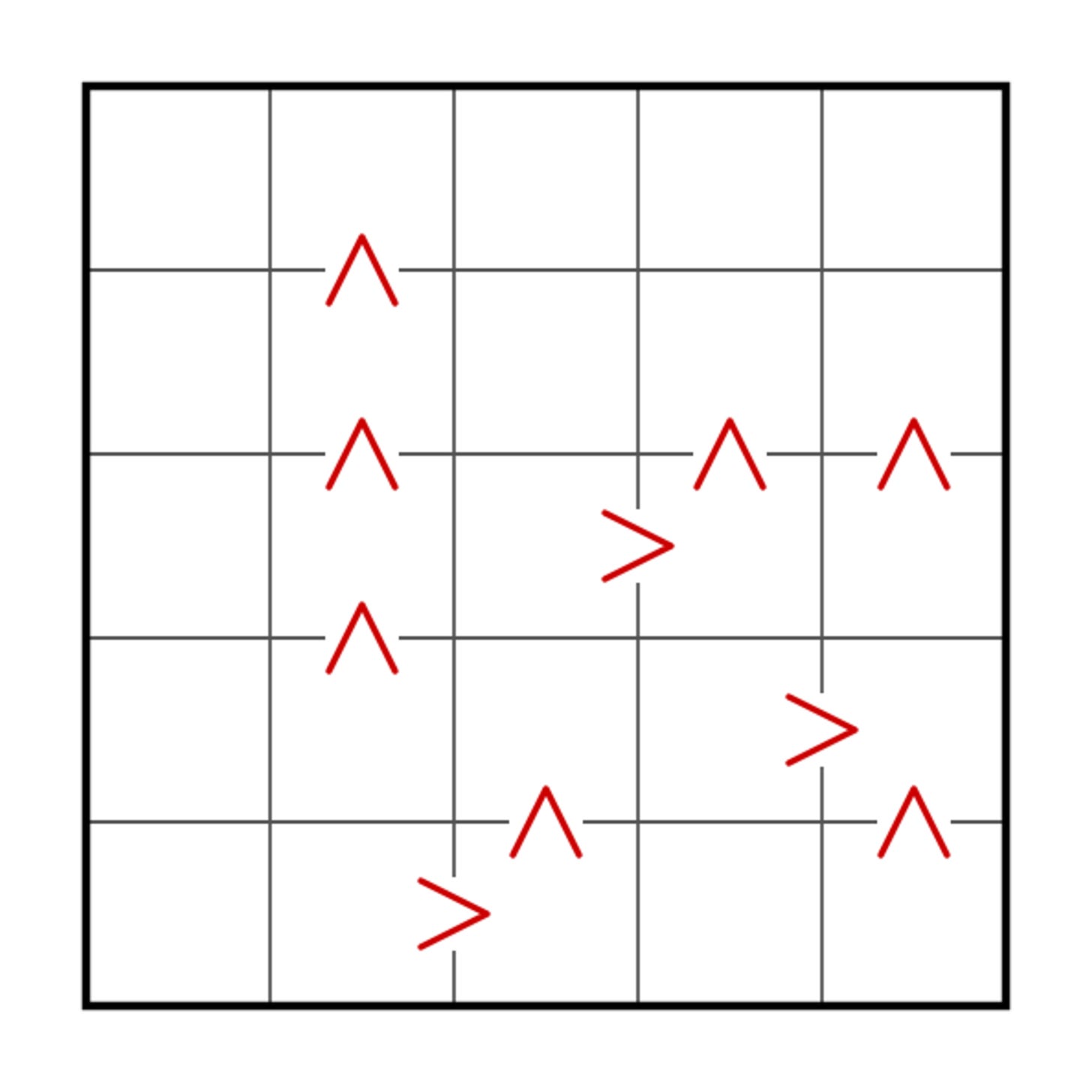
This month’s next puzzle is Futoshiki. The puzzle originated in Japan, and its name translates to “inequality,” which is kind of the main idea behind the whole puzzle. Its creation is credited to Tamaki Seto in 2001. Within a few years, Futoshiki found its way into newspapers outside Japan and became a well known logic puzzle. You will also sometimes find it under the names Unequal or More or Less.
Futoshiki takes the simple rules of a Latin square and adds inequality signs to the grid. With this small addition, it creates a puzzle that can become surprisingly challenging.
And Now, the Rules
Fill every row and column with numbers from 1 to N, where N is the size of the grid.
All numbers in each row and column must be unique.
The numbers in the grid must satisfy all inequality signs between cells.
Another puzzle with very simple rules that can be either extremely easy or surprisingly complicated, depending on only a few small inequality signs.
A good place to start is usually by looking for the smallest and largest numbers in the grid. These numbers are often the easiest to deduce. Because of this, larger grids are usually harder. After finding possible positions for the smallest and largest numbers, you still have numbers in between to work out which in a larger grid can become quite a challenge.
Usually, you start by searching for rows and columns where inequality signs eliminate the most positions for the smallest or largest number.
The pointed side of an inequality sign always faces the smaller number, while the wide open side faces the larger number. Because of this, a cell on the smaller side of an inequality can’t contain the largest number in the grid, and a cell on the larger side can’t contain 1.
By scanning the grid, you can use these two simple rules to eliminate many possible positions for 1 and the largest number. After doing this, you continue with normal row and column logic and try to place as many of these numbers as possible.
In harder puzzles, you usually won’t be able to fill every row or column this way. The next thing to look for is a chain of cells connected by inequality signs.
For example, if several cells form an increasing or decreasing chain, you can determine the minimum or maximum values that some of those cells can contain. These chains will not always give you the exact numbers immediately, but they can substantially reduce the number of possible candidates.
If you are familiar with Sudoku solving strategies, some of them can also be useful in Futoshiki. Candidate pairs and similar eliminations can help you determine which numbers must appear in other cells of a row or column.
Solving the Puzzle
But it will probably be easier to understand all of this if we solve one puzzle together and go through some of these techniques step by step. We will solve an easy to medium 5×5 puzzle. As always, R1-R5 stand for Rows 1 to 5, and C1-C5 stand for Columns 1 to 5. A specific cell would be written as R1C1 for the first cell in the first row and first column.
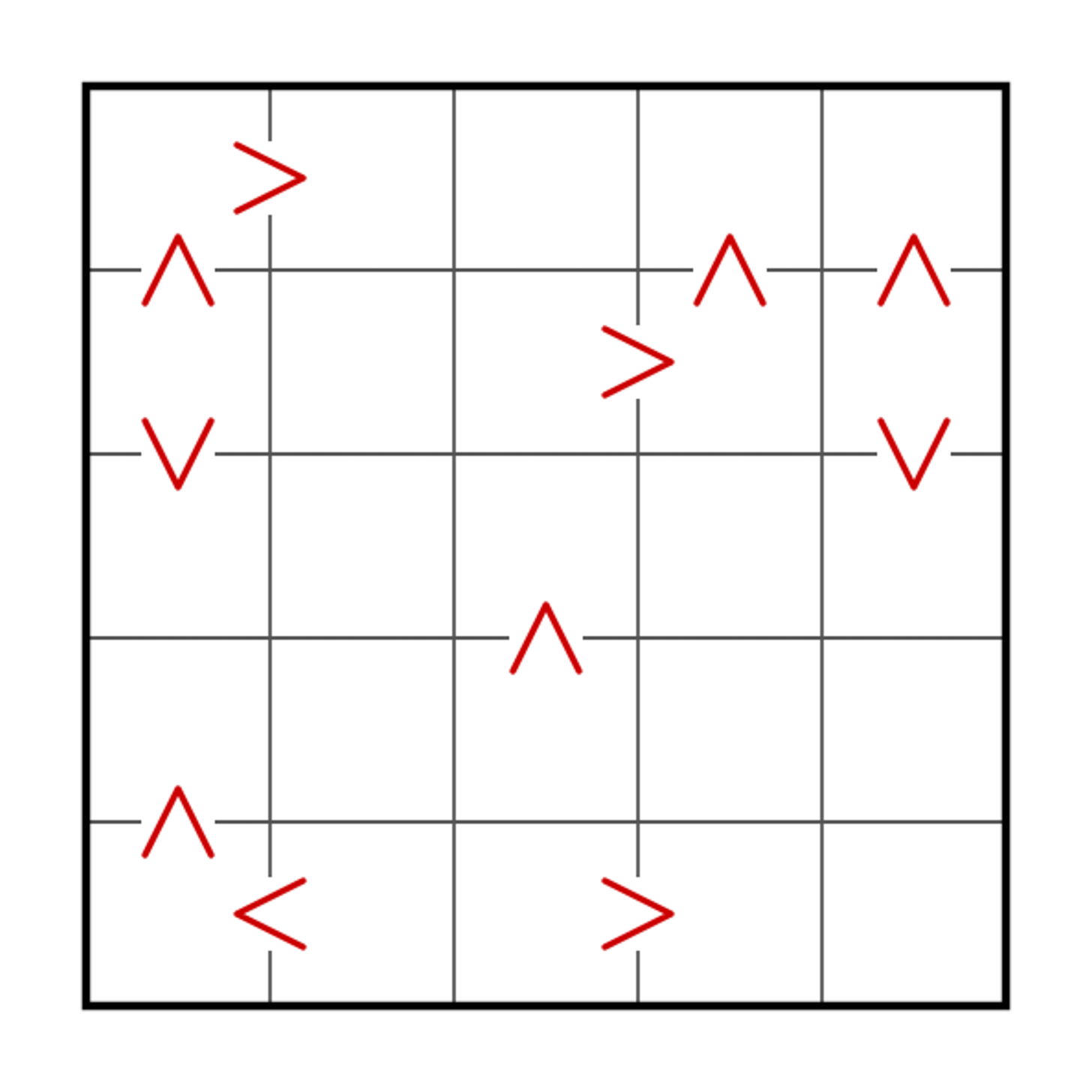
Our first step will be to check the inequality signs in R1. As you can see, all cells except one have the pointed part of an inequality sign facing them. From this, we can deduce that R1C3 contains 5 because 5 can’t be placed anywhere else in that row. After that, let’s look at C3. All the remaining cells except R3C3 have the wide open part of an inequality sign facing them, so we know that R3C3 is the only cell that can contain 1.
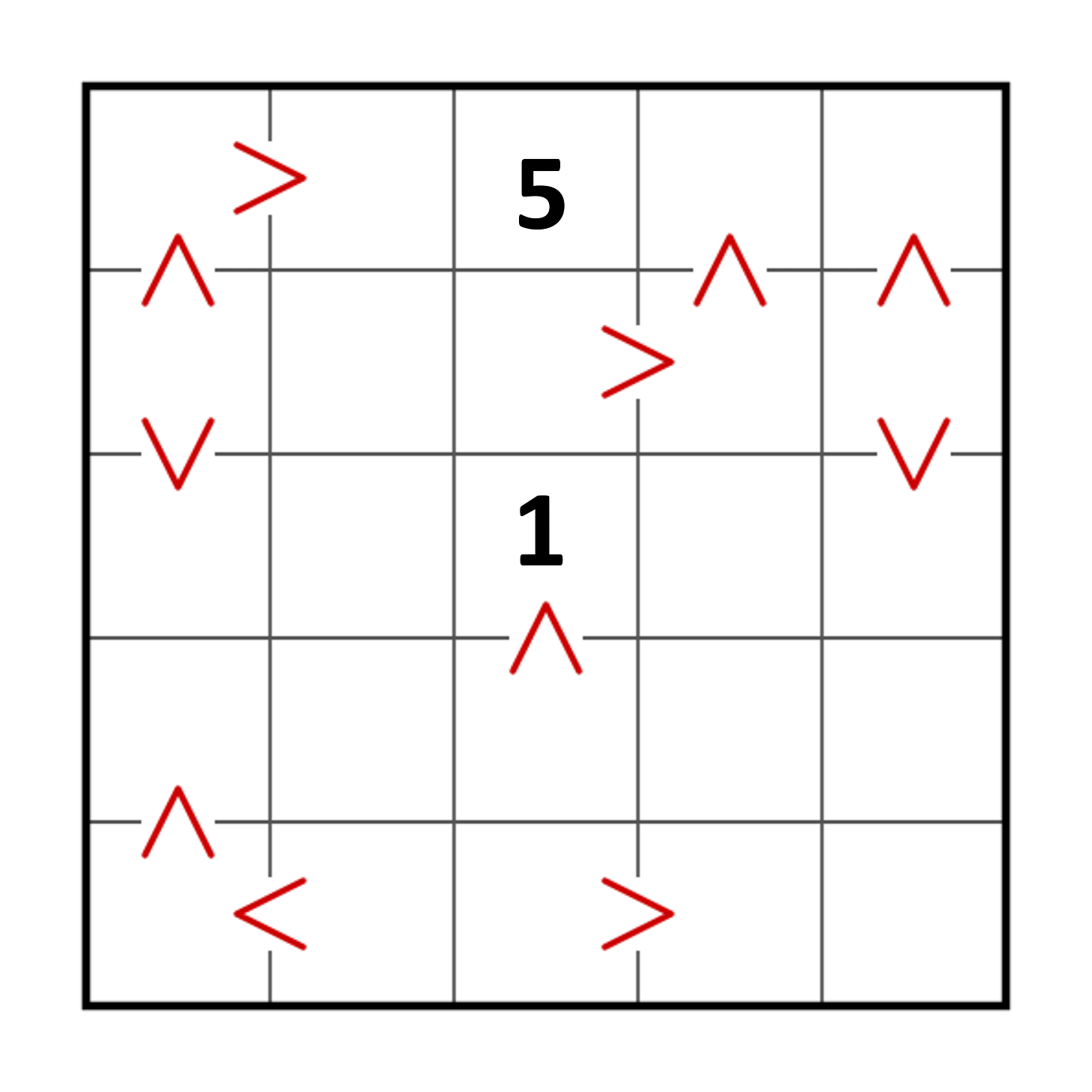
Now, if we look at R2, there is also only one place where we can put 1, and that is R2C2. All the other cells need to contain a number that is bigger than another number.
The same deduction works in C1, where R4C1 is the only cell that can contain 1.
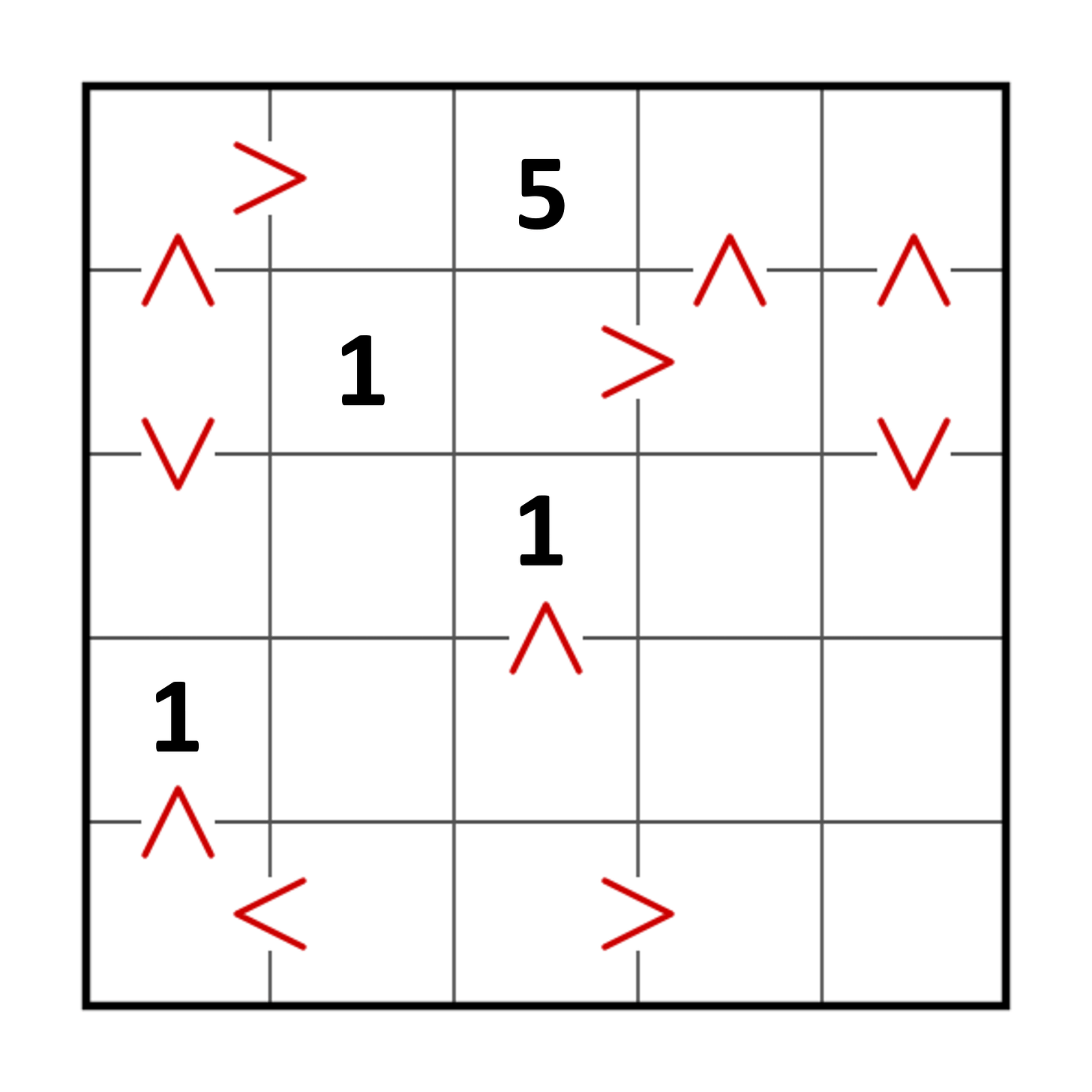
After these first easy numbers, we hit a bit of a wall. We can’t go much further using only this basic logic. The chained cells also eliminate a few candidates, but they don’t immediately give us a way forward.
However, this puzzle has one interesting inequality placement. Look at R2C1 and R2C5. What can we deduce from them?
Both cells need to contain a number that is bigger than two other numbers. From this, we can deduce that neither cell can contain 2. The numbers in them must be at least 3, so they can only contain 3, 4, or 5.
R2C3 is at the start of a chain of three cells, so it also needs to contain a number bigger than 2.
From all of this, we can see that R2C4 is the only cell in the row that can contain 2.
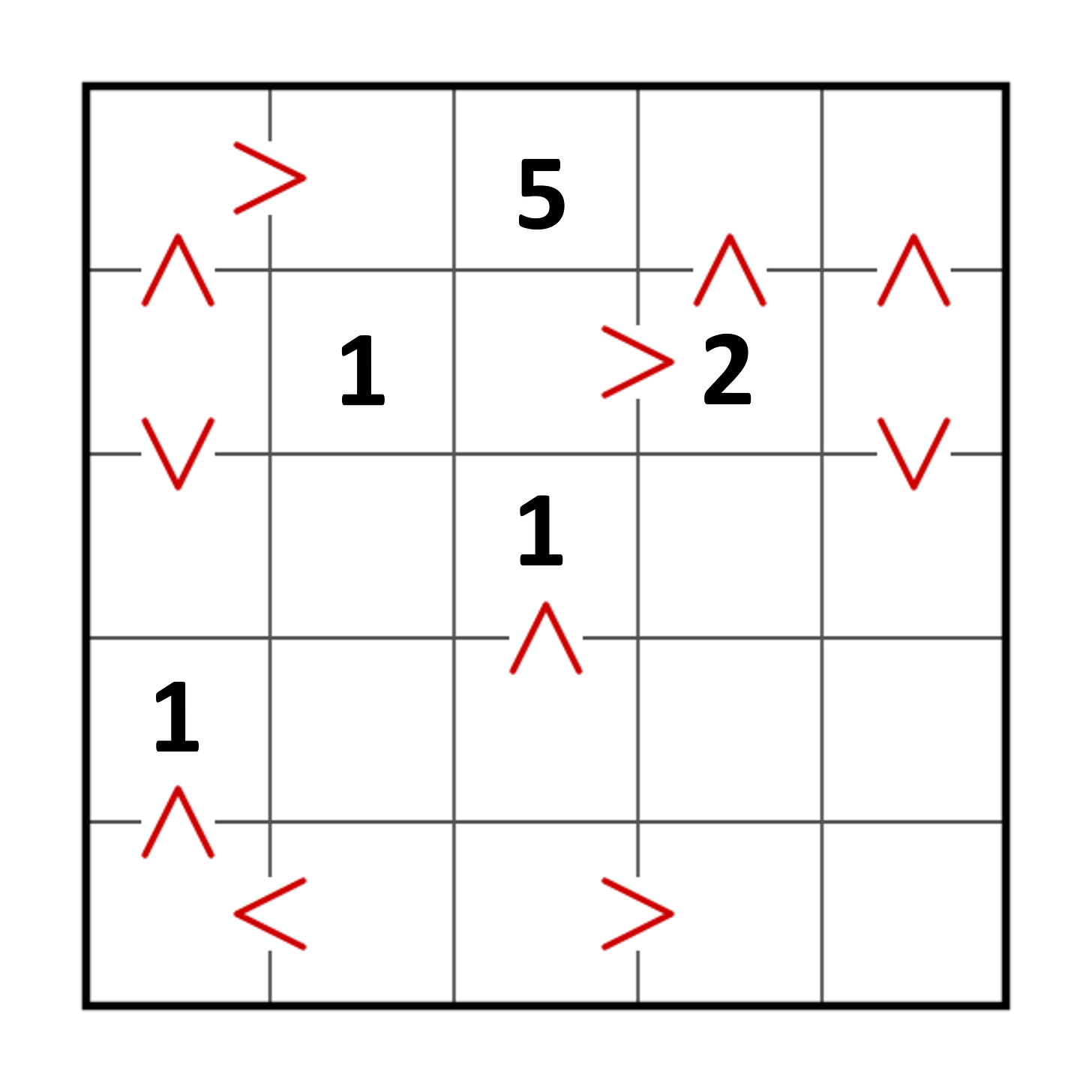
This is the key moment in this puzzle. Most of the logic after this will be much easier to see.
Let’s see what placing 2 in R2C4 opens up. R1C4 needs to contain a smaller number, so it must be 1.
We can also determine R5C4 and R5C3. In C4, we have already used 1 and 2, so R5C4 can only contain 3, 4, or 5. It can’t contain 5 because R5C3 needs to contain a larger number. It also can’t contain 4 because that would force R5C3 to be 5, but we already have a 5 in C3.
The only number remaining for R5C4 is therefore 3, and consequently R5C3 must be 4.
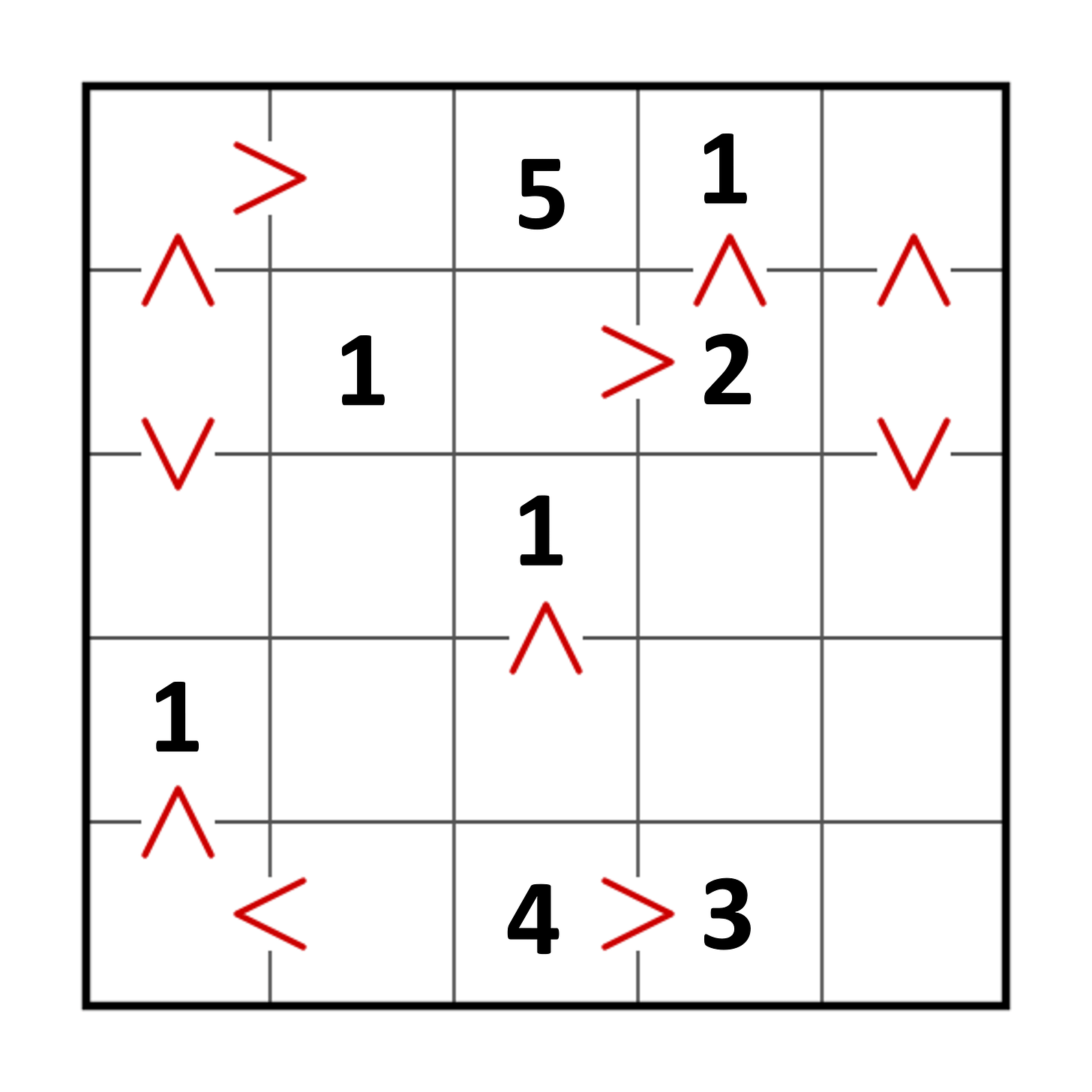
We can now finish C3 easily. There is only one cell where we can place 2, and after that only one cell remains for 3.
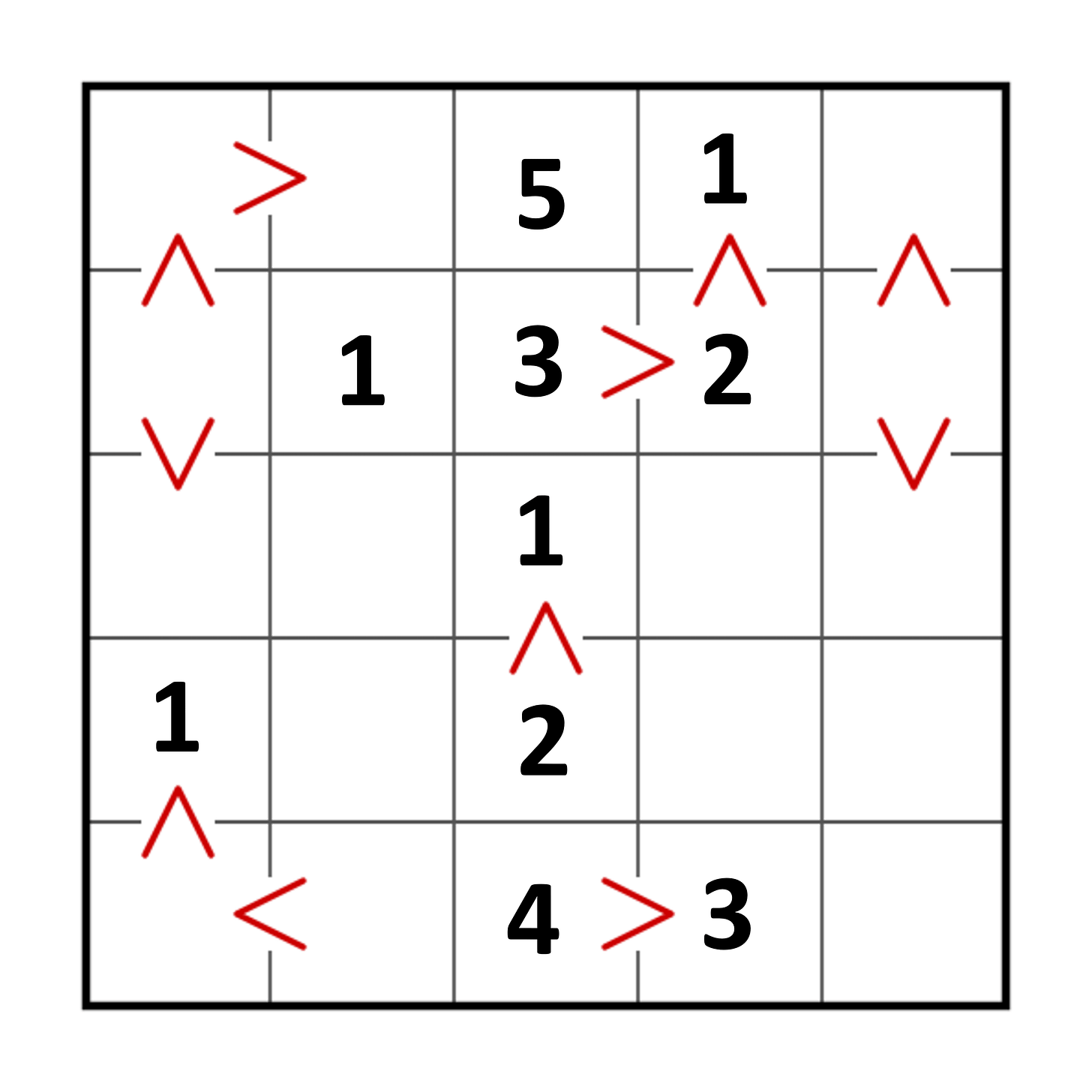
Now we can move to R5. This row is wide open because R5C5 is the only remaining place for 1. The inequality signs then tell us that the two remaining numbers must be 2 in R5C1 and 5 in R5C2.
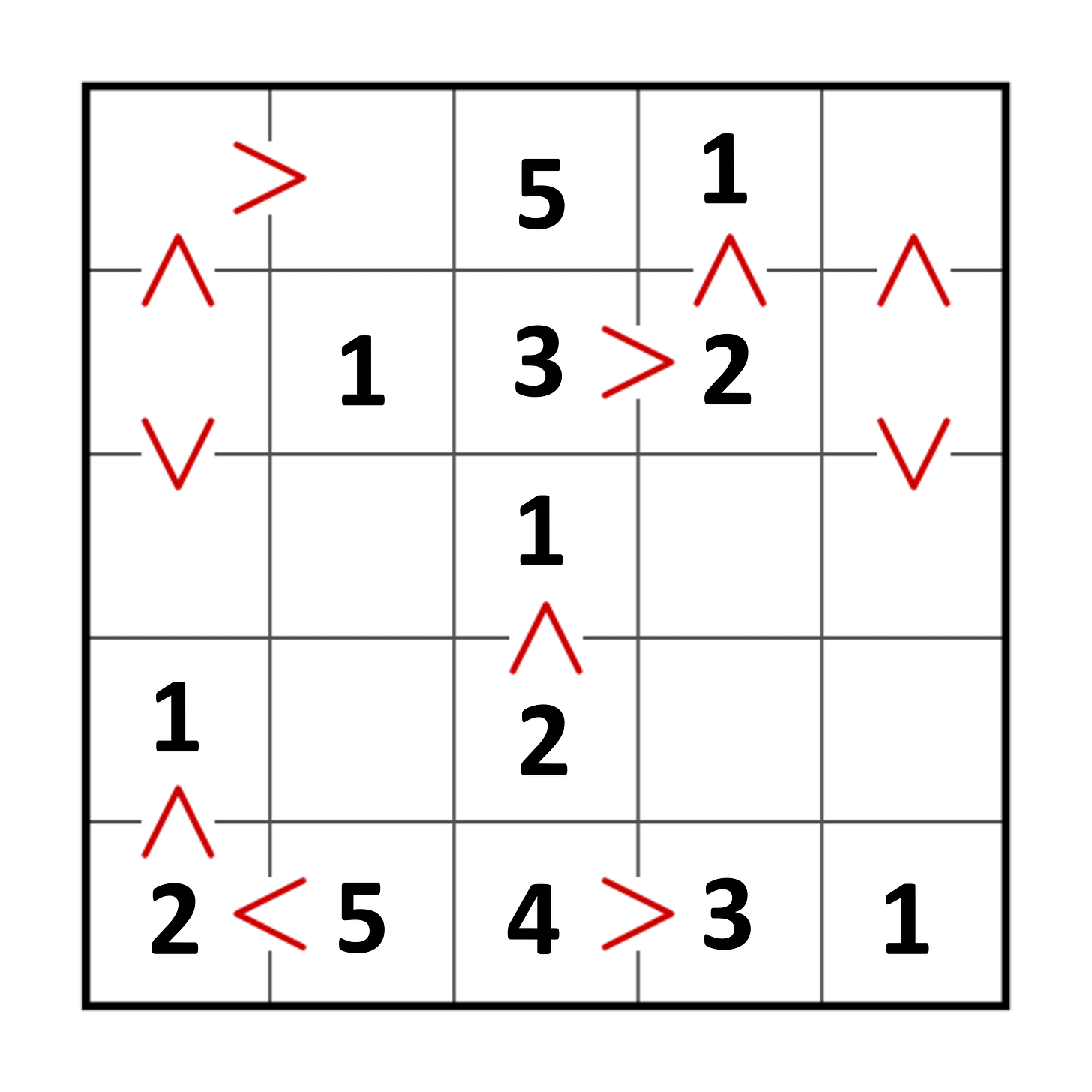
Moving to R3, we can see that the only possible cell for 5 is R3C4. All the other cells either need to contain smaller numbers or are blocked by a 5 already placed in their column. After placing 5, the only remaining cell in C4 is filled with the only remaining number, 4.
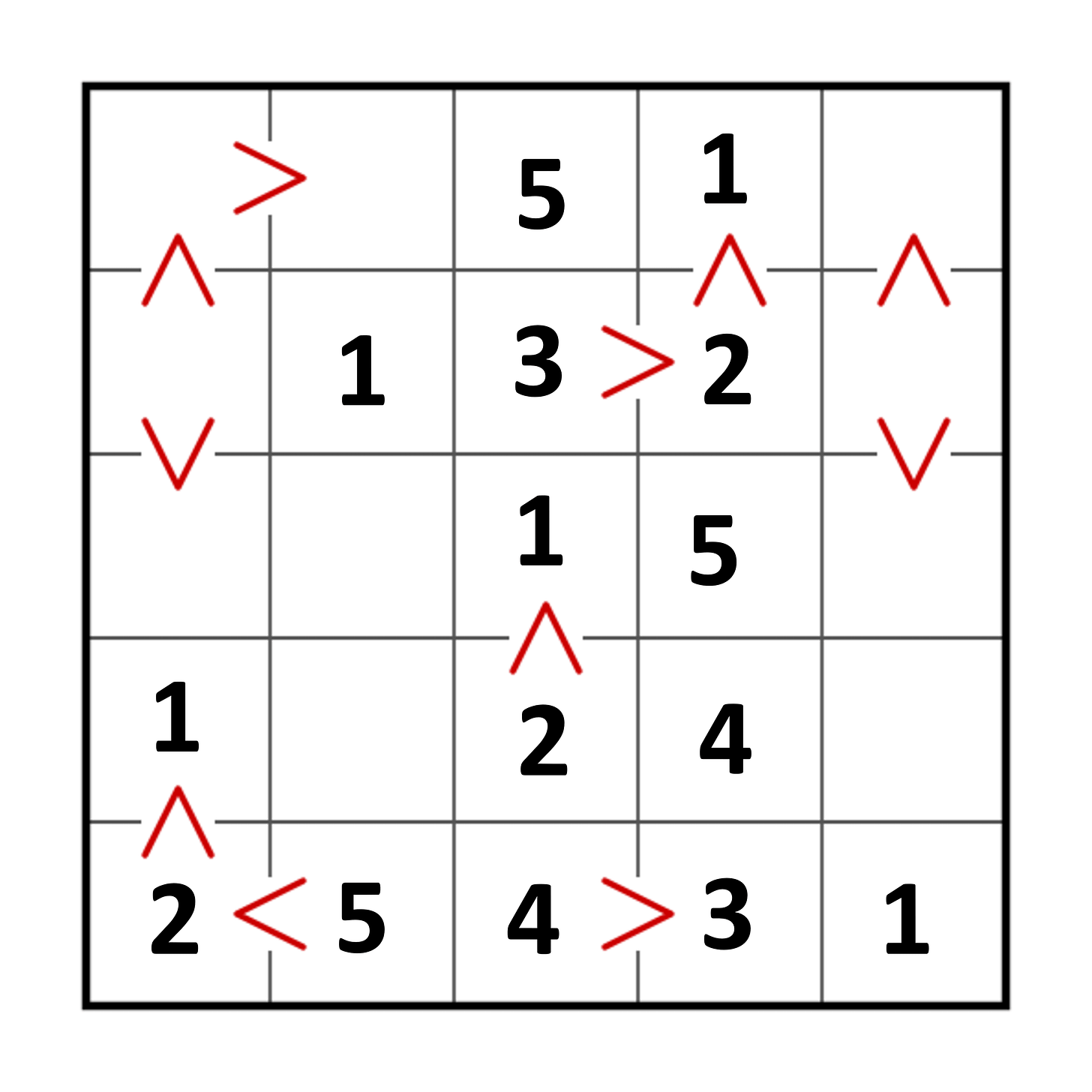
Moving to R4, we can fill 5 and 3 in the remaining cells. We then move to C2 and fill in 2 and 4. Here we can also see that R1C2 needs to contain 2 because of the three-cell inequality chain. The chain can’t start with 4 because there would not be enough larger numbers available to complete it.
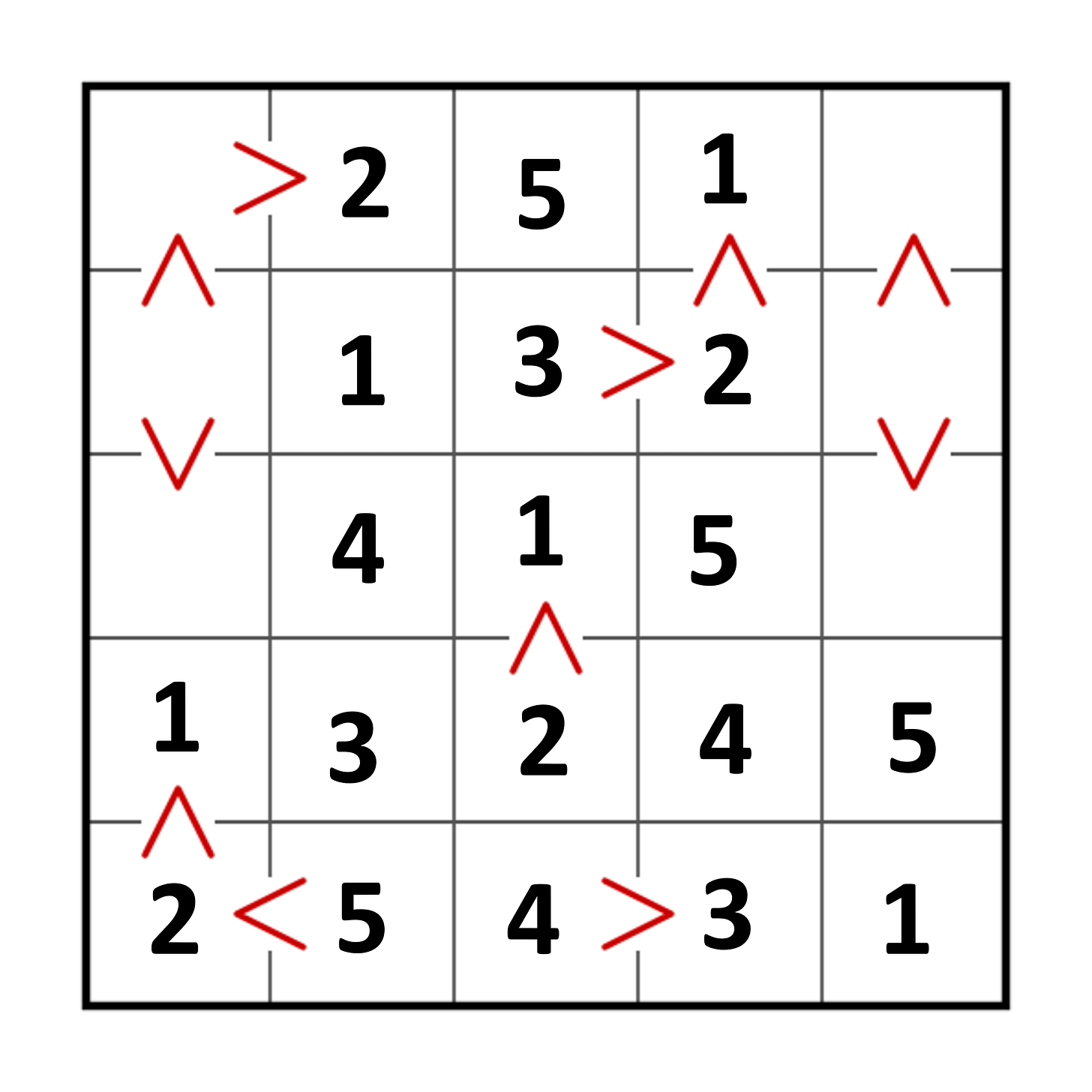
Moving back to R2, we can fill 5 and 4 in the remaining cells. Then we move to R1 and finish the row with 4 while respecting the inequality signs.
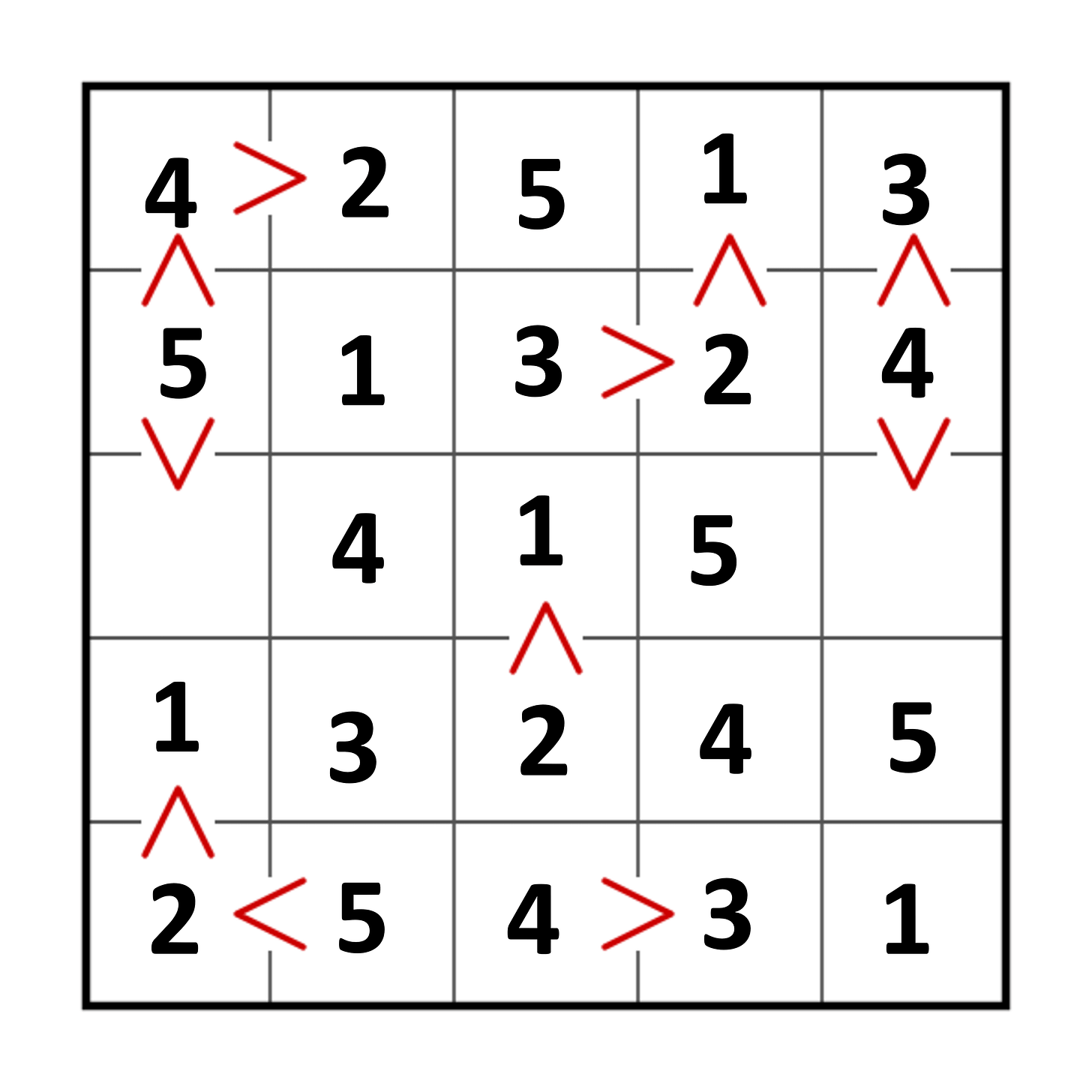
Finally, we finish R3 by placing 3 and 2 in the last remaining cells.
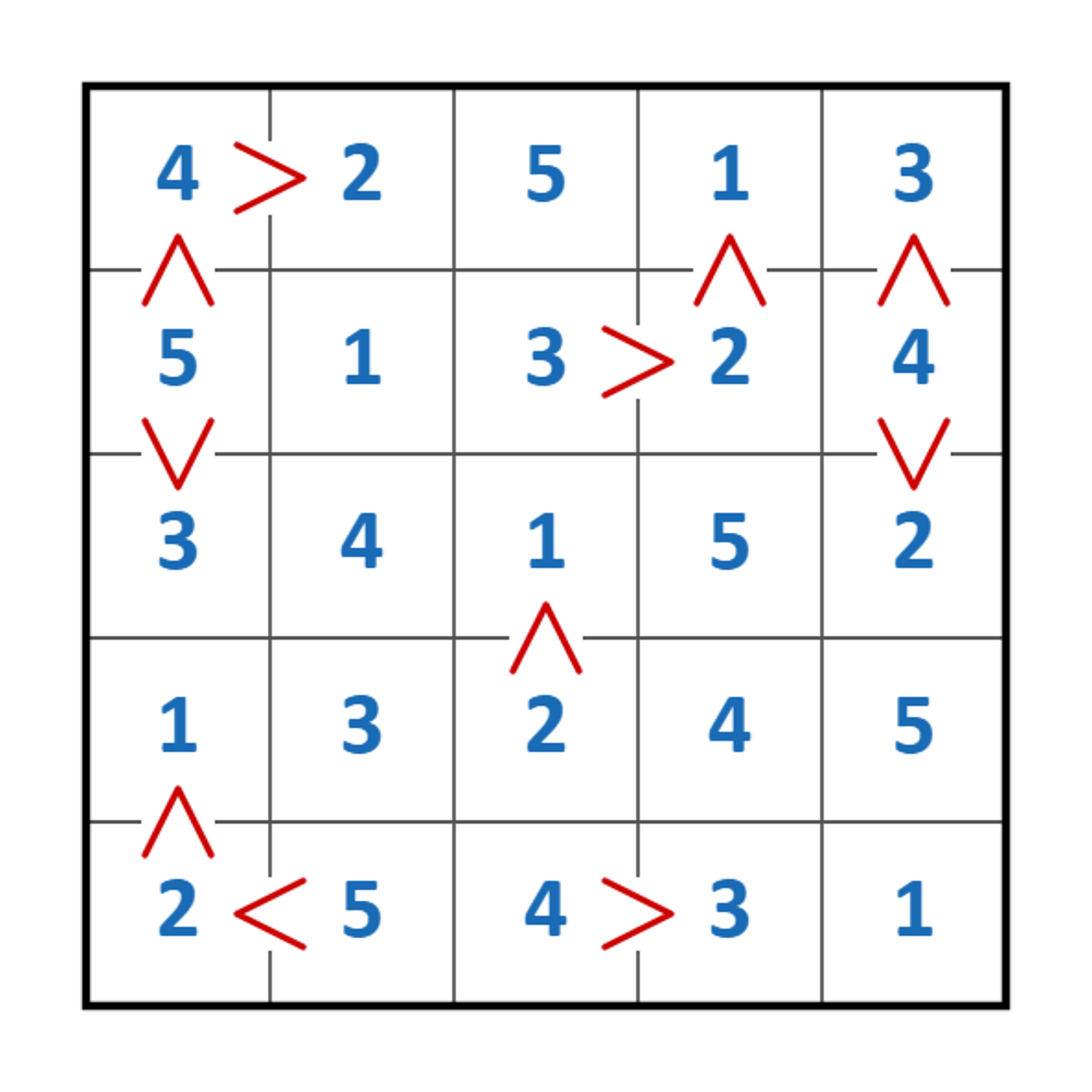
After a slightly harder deduction near the start, the rest of the puzzle was relatively easy. Harder Futoshiki puzzles contain many more deductions like the one we used in R2, where you need to look beyond individual inequality signs and consider how several of them work together.
Variants
The simple inequality rule is easy to combine with other puzzle mechanics, so you can find many different Futoshiki variants.
Some puzzles combine it with consecutive number rules or odd/even rules. The grid can also be changed from square to hexagonal, something we see quite often with different puzzle types.
You can also go in the other direction and find inequality rules added to Sudoku and other number placement puzzles. It is such a simple rule that, especially when combined with Sudoku, it can sometimes be difficult to say which puzzle is the variant of which. So I will let you be the judge of that. 🙂
The important thing is to try the puzzle, and if you enjoy it, you can explore the other similar puzzles out there. Maybe some of them will appear in a future Your Next Puzzle article.
I’m personally not a great fan of Futoshiki, but I won’t skip it. I hope you won’t skip it either the next time you see one, which will probably be right now because, as always, I will leave you with a puzzle to try for yourself. 😀
Happy puzzling!