
What makes Skyscrapers truly captivating is the “Aha!” moment that comes with every successful deduction. It is less about guessing and more about building a logical bridge across the grid, where each clue acts as a constraint that slowly reveals the hidden cityscape.
For the second puzzle in the Beyond Sudoku series, I picked Skyscrapers. This puzzle originated in Japan and is usually credited to Masanori Natsuhara, who created it in 1992. It first appeared in the Japanese puzzle magazine Puzzler, and it received early international exposure through the 1st World Puzzle Championship in New York City that same year. The puzzle is also known by names such as Towers, Building City Puzzle, Building Puzzle, Building Heights, and sometimes Skyline puzzle.
Before we start solving, let’s go over the rules.
The Rules: The goal is to complete an N × N city grid using the numbers from 1 to N. Each number represents a building height: 1 is the shortest building, and N is the tallest. As in Sudoku, every row and every column must contain each height exactly once.
The numbers outside the grid are viewing clues. Imagine standing at that side of the city and looking across the row or column. You count only the buildings you can actually see from that direction. A taller building blocks any smaller buildings behind it, so the clue tells you how many buildings should be visible from that direction.
The rules are simple, but they can create a lot of fun deductions. You can start with small grids where all side clues are provided, and then move on to larger grids or puzzles with fewer clues. This is also a puzzle where grid size really changes the solving experience. A bigger grid does not just take more time; it also creates more complex logical relationships.
Let’s look at an example of a 5 × 5 grid and see how to build the city.
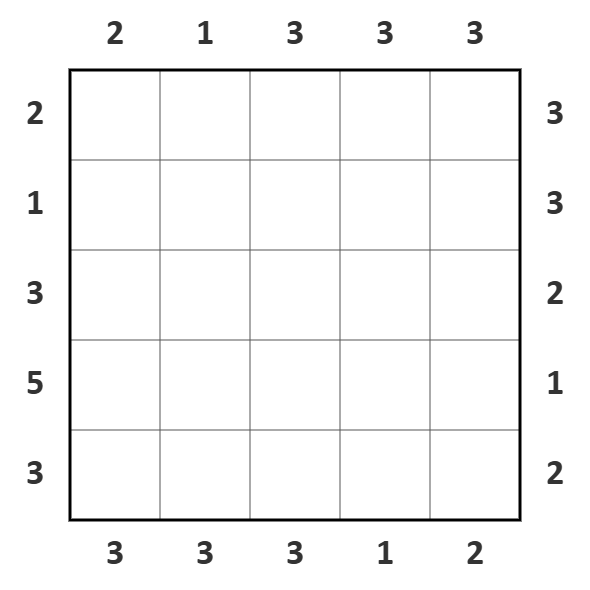
This is an easy puzzle with all clues provided. While reading, try to fill the numbers into an empty grid so you can follow the deductions more easily. I will use standard grid notation: R1C1 means row 1, column 1; R4 means the fourth row from top to bottom; and C4 means the fourth column looking from left to right.
A good solving strategy is to start with the largest and smallest clues. In a 5×5 grid, that means looking first for clues 1 and 5.
A clue of 5 means that all buildings are visible from that direction. Since every building must be taller than the one before it, the row or column must be filled in increasing order: 1, 2, 3, 4, 5. In our example, this lets us fill the entire fourth row, R4.
The other common opening clue is 1. A clue of 1 means that only one building is visible from that direction, so the tallest building must be placed in the first cell seen from that side. In a 5×5 puzzle, that means placing a 5 in that position.
In our example, the clues let us place several 5s. After those are filled in, only one row and one column are still missing a 5, so the final 5 must go in their intersection, the middle of the grid.
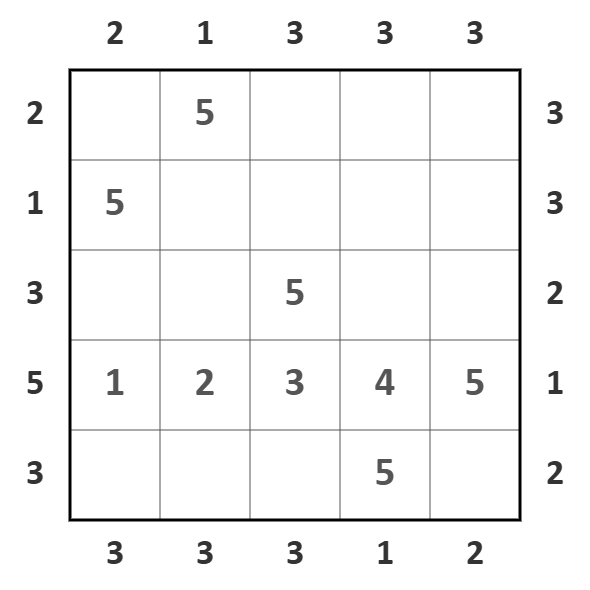
Now look at the fourth column, C4. At this point, R4 is already filled, and all the 5s are placed. In C4, we need exactly 3 buildings to be visible. Since the 4 and 5 at the end of the column will always be visible, we need to stop the smaller buildings before them from adding too many visible buildings. The only way to do that is to place 3 at the start of C4. That 3 blocks the 1 and 2 behind it, so for now we do not even need to know the exact order of those two numbers. If we placed 1 or 2 in the first cell of C4 instead, the 3 would still be visible later, giving us at least 4 visible buildings, which would break the clue.
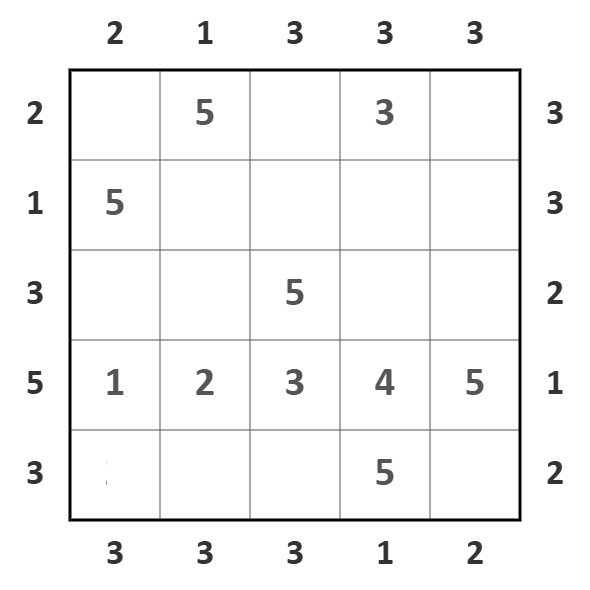
Now the easiest placements are done, so the next step is to look for the 4s. They are the next-tallest buildings, so their positions are often easier to restrict.
In R1, the 4 can only go in the first cell, R1C1. In the other unfilled columns, the clues require 3 buildings to be visible, so placing a 4 there would not work. Once we put 4 in R1C1, the first column opens up. Looking from the bottom clue of C1, we need to see 3 buildings, so the remaining 2 and 3 must be placed in that order. From top to bottom, C1 becomes 4, 5, 3, 1, 2.
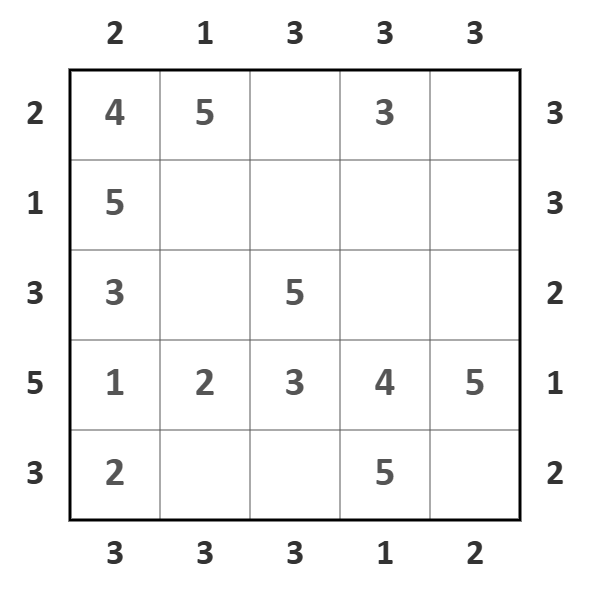
We can use the same idea in the last row, R5. For the same reason as in R1, the 4 in R5 can only go in the last cell, R5C5. Placing it there opens up the rest of R5, so we can place the remaining 1 and 3. The 1 must go in R5C3 because of the bottom clues. If it went in R5C2, then more than 3 buildings would be visible from the bottom in C2. That means the 3 goes in R5C2.
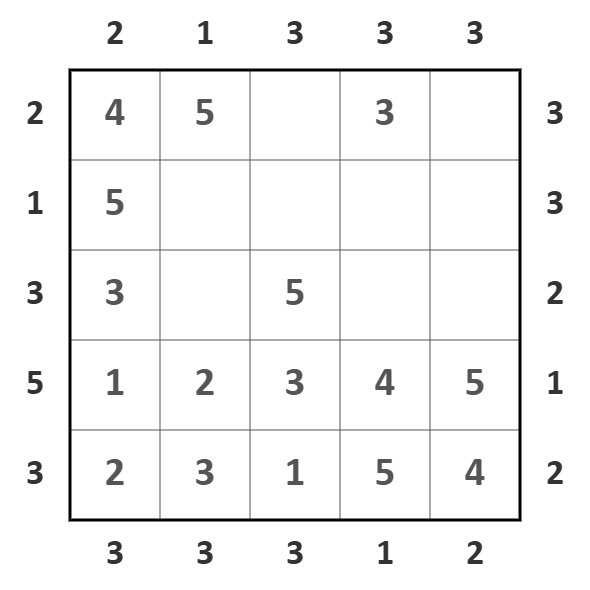
Next, we fill the middle column, C3. The remaining numbers there are 2 and 4, and they must be placed in the order that satisfies the top clue of 3 visible buildings.
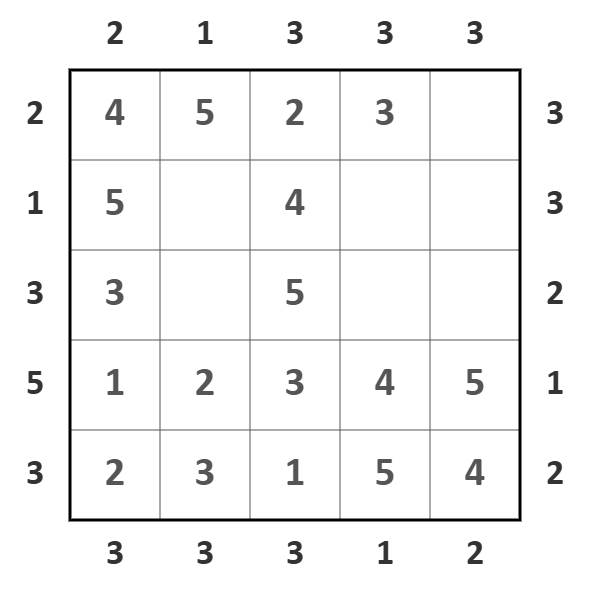
After that, we can finish R1 by placing 1 in the last cell, R1C5. This opens up the last column, C5, where we can place 3 and 2 in the order required by the top clue.
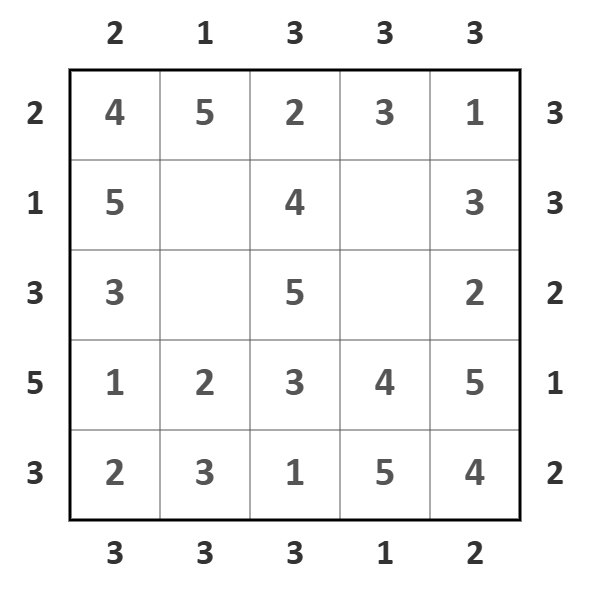
Then we move to the middle row, R3. The remaining numbers there are 4 and 1, and their positions are forced by the left and right clues.
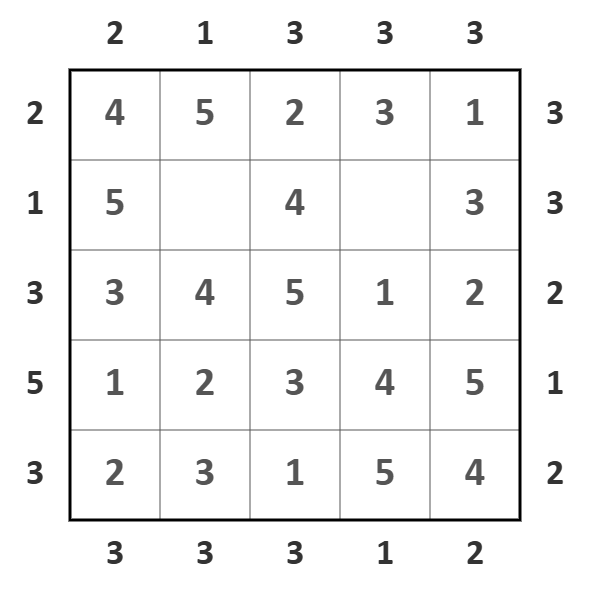
To finish, we complete R2. At this point, the remaining unfinished columns each have only one missing number, so the final placements are straightforward.
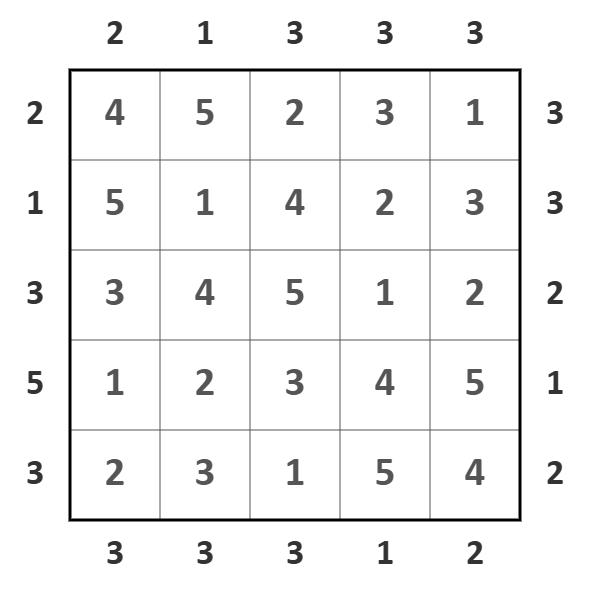
That was a fairly easy puzzle, and once you understand the rules and the basic logic, you can solve it in under five minutes. A more complex puzzle may have only a few clues and can give your brain a real workout.
Skyscrapers rules also appear in different puzzle hybrids and variants. The most familiar one is probably Skyscraper Sudoku, where regular Sudoku rules are combined with visibility clues around the edge of the grid. The numbers still behave like building heights, so the outside clues give you another layer of logic on top of the usual row, column, and box restrictions.
Another interesting variant is Hexa Skyscrapers. It keeps the same basic idea of taller buildings blocking shorter ones, but moves the puzzle onto a hexagonal grid. Because the grid has different directions and paths to consider, the solving logic feels familiar but not identical. These variants show how flexible the Skyscrapers rule set is: a simple visibility idea can create many different kinds of deductions.
These are only a few examples of Skyscrapers variants. There are many more out there, even if they are not as widely known or as popular as Sudoku variants.
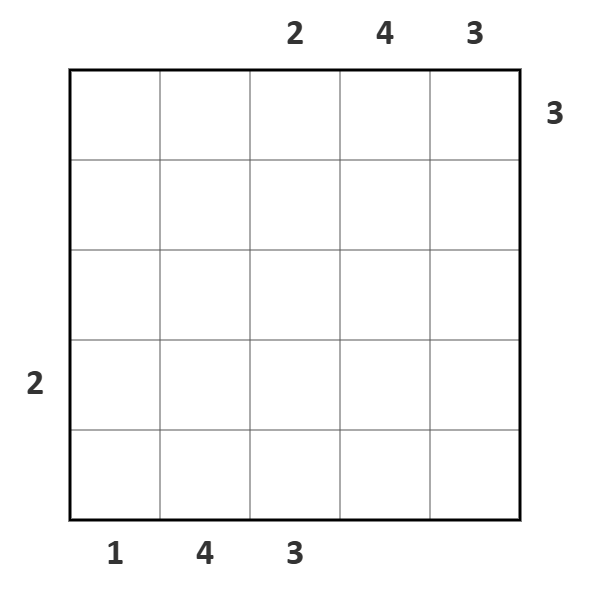
To finish, I leave you with a harder puzzle. I hope this article has made you curious enough to explore this wonderful little city of logic.
Happy solving!